
Most productivity losses don’t start with a failure big enough to set off alarms. They creep in quietly.
- A conveyor slows just enough to create a backlog.
- A sorting belt hesitates because a sensor is blocked.
- Automation pauses while everyone assumes someone else is already handling it.
Five minutes pass. Then ten. Then thirty. Across a single facility, it’s frustrating. Across hundreds of facilities, it’s expensive.
For infrastructure-heavy organizations operating manufacturing plants, warehouses, and logistics hubs across multiple states, downtime doesn’t stay localized. It compounds. And by the time leadership sees it in a report, the opportunity to protect productivity is already gone.
AI-enabled cameras change that equation. Not by watching operations, but by actively sensing when productivity is at risk and alerting teams in real time:
- AI-enabled cameras detect early signs of downtime and throughput disruption in real time
- Real-time alerts allow teams to intervene before small issues become costly delays
- .AI cameras act as operational sensors, not passive recording tools
- When deployed at scale with Federated Service Solutions, AI-enabled cameras protect productivity across large, distributed operations
What Are AI-Enabled Cameras for Productivity Monitoring?
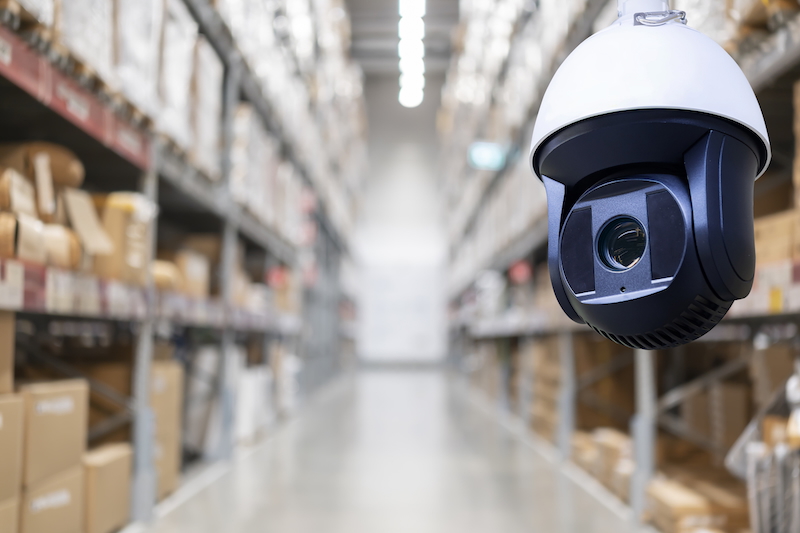
AI-enabled cameras are computer vision-powered systems that monitor operational flow and detect deviations that signal downtime or reduced throughput.
Unlike traditional video cameras that require manual review, AI-enabled cameras analyze live video feeds to identify stalled equipment, congestion, and abnormal motions, triggering real-time alerts before productivity is impacted.
From Passive Video Cameras to AI-Powered Operational Sensors
Traditional cameras tell you what happened after the fact. AI-enabled cameras tell you when something starts to go wrong. In manufacturing, logistics, and warehousing, AI cameras identify:
- Conveyor belts slowing or stalling
- Equipment idling outside expected cycles
- Packages backing up on sorting lines
- Automation halted due to blocked or tripped sensors
- Flow disruptions between process stages
But this capability only delivers value when it’s deployed consistently across every location, not just piloted in a handful of facilities. For large, distributed organizations, fragmented implementations create blind spots. Uniform execution across all sites is what turns insight into real productivity protection.
How Do Real-Time AI Alerts Protect Throughput and Prevent Downtime
Productivity suffers not because disruptions happen, but because they linger unnoticed. AI-enabled cameras close that gap by pushing real-time alerts to the people who can act. Instead of supervisors watching screens or discovering issues during walkthroughs, alerts surface the moment operational flow changes.
This approach supports smoother operations at scale:
- Managers aren’t tied to dashboards
- Local teams act faster with clearer context
- Leaders gain confidence that issues are flagged immediately
At enterprise scale, speed isn’t about reacting faster than yesterday. It’s about ensuring response time doesn’t slow down as the organization grows.
How AI-Enabled Cameras Prevent Conveyor Failures and Production Stoppages
In manufacturing environments, conveyor failures rarely begin as full stops. They start with subtle changes, product clustering, spacing irregularities, movement hesitation. AI cameras detect those early signals:
- Material stacking at transfer points
- Irregular belt motion
- Slowing throughput that signals an imminent jam
This is where responsiveness matters. Detection rules, alert thresholds, and workflows must adapt quickly as production demands shift. Solutions that can’t pivot at the pace of operations inevitably fall behind, especially across large networks where no two facilities are identical.
This is productivity protection, not damage control.
How to Stop Conveyor and Sortation Bottlenecks Before They Impact Productivity
In distribution centers, flow is everything. Once packages back up, the clock is already working against you.
AI-enabled cameras monitor density and movement patterns across sorting belts, flagging abnormal buildup before delays cascade downstream. The result isn’t just fewer problems; it’s smoother more predictable throughput during moments that matter most.
Across large networks, this coordination depends on more than technology. It requires a long-term hands-on approach that treats productivity as something to be continuously protected, not temporarily fixed.
When systems evolve alongside operations, instead of lagging behind them, productivity stops being fragile. Productivity gains don’t come from one-time deployments. They come from ongoing tuning, sharing accountability, and a commitment to evolve as operations change.
How AI-Enabled Cameras Detect Automation Pauses and Line Stops in Real Time
Automation doesn’t always fail loudly. Often, it stops silently due to a blocked sensor or minor obstruction.
AI cameras recognize when:
- Equipment is idle but should be active
- Automated movement suddenly ceases
- Material flow stops without a logged error
No more waiting for a report or walkthrough, teams are alerted immediately. Automation behavior is recognized when it changes; when motion ceases, when flow stalls, when equipment sits idle outside its normal pattern.
Across hundreds of locations, even small automation stops compound quickly. The organizations that protect productivity aren’t the ones with the most dashboards, they’re the ones that know the moment something stops.
Federated Service Solutions: The Critical Enabler Behind Scalable Enterprise AI Deployments
Many companies can install cameras. Few can support enterprise-scale operations the way Federated Service Solutions does.
This is where partnership becomes operational, not philosophical. And we operate as a long-term partner,not a short-term vendor. Productivity gains don’t come from one-time installs, they come from ongoing optimization, alignment with business goals, and a shared commitment to performance over time.
With a true operational presence across the United States, Canada, and U.S. territories, FSS delivers consistent deployment and support no matter how large or geographically complex the footprint. That means standardized execution, not fragmented results.
One AI-Enabled Camera Platform Driving Enterprise-Wide Operational Efficiency
AI-enabled cameras aren’t single-purpose tools. They sit at the intersection of productivity, safety, and security.
The same system that detects downtime can:
- Support safety awareness
- Enhance security visibility
- Provide operational insight
For large organizations, this convergence matters. It reduces system sprawl, simplifies decision-making, and creates ROI that leadership can defend.
Most importantly, it creates alignment. Operations, safety, and security stop competing for attention and start working from the same source of truth.
Real-Time Operational Visibility with AI Cameras Boosts Enterprise Productivity
Downtime will always exist. But prolonged downtime doesn’t have to.
Organizations that deploy AI-enabled cameras with real-time alerts gain something powerful: the ability to act before productivity slips, across every site, every shift, every process.
FSS’ capability is supported with:
- The scale to execute everywhere
- The speed to pivot as operations change
- A partnership built for the long term
Productivity stops being reactive, it becomes resilient.
To explore how real-time AI alerts can protect productivity across your entire footprint, contact FSS today.