
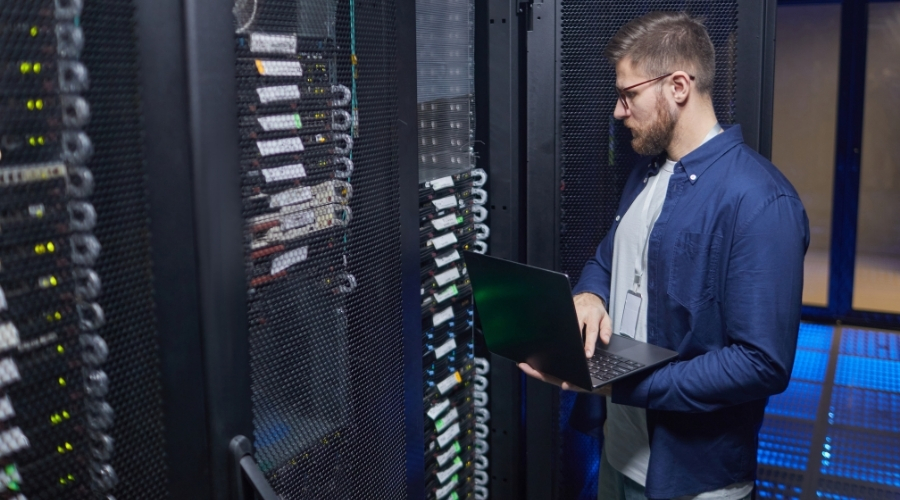
Data centers are expected to stay operational all the time.
Not “most of the time.”
Not “when conditions are ideal.”
All the time.
Because when critical infrastructure goes down, the impact spreads fast — across operations, communications, customers, applications, supply chains, and revenue.
That’s why mission-critical data center infrastructure requires more than redundant hardware and optimistic SLAs.
It requires operational readiness.
From resilient network architecture and proactive monitoring to rapid-response support and infrastructure visibility, always-on environments depend on systems designed to identify problems before they become outages.
Because in mission-critical operations, uptime is never accidental.
Always-On Means No Margin for Error
Modern data centers do not close, they do not pause, and they do not get a second chance.
They operate 24/7/365 because the enterprises they support operate 24/7/365. Financial systems. Healthcare networks. Logistics platforms. Enterprise applications. Every second of uptime sustains revenue, customer trust, and contractual commitments.
Even brief outages carry disproportionate consequences. Lost transactions. SLA penalties. Brand damage. Internal disruption that ripples far beyond the facility walls.
In this environment, infrastructure reliability is not a performance metric. It is a foundational requirement. Always-on means no margin for error.
What Is Mission-Critical Infrastructure?
Mission-critical infrastructure refers to systems, facilities, and technologies that must remain operational to support essential business functions, communications, security, or service delivery.
In data center environments, mission-critical infrastructure may include:
- Core network systems
- Enterprise wireless infrastructure
- Power and backup systems
- Environmental monitoring
- Security systems
- Connectivity infrastructure
- Cloud and edge networking
- Monitoring platforms
- Cooling systems
- Communication systems
Failure in these environments can lead to operational disruption, financial loss, compliance risk, and service outages.
That’s why resilience, monitoring, and rapid response are essential.
What “Always-On Infrastructure” Really Requires
Redundancy is essential, however redundancy alone is not enough.
True always-on infrastructure depends on stable physical and network layers that perform consistently under real-world conditions. Structured cabling must be precise, wireless coverage must be validated, and hardware deployments must be consistent and documented.
Continuous performance is built on disciplined deployment validation. Predictive designs must be tested. Installations must be verified. Documentation must be accurate and accessible.
Because when something fails, and eventually something will, clarity and consistency determine recovery speed. Always-on infrastructure is engineered, not assumed.
What Challenges Do Mission-Critical Data Centers Face?
Today’s data centers are evolving at a relentless pace.
- Rapid expansion and increasing density. Higher compute loads, tighter rack configurations, and growing power demands strain legacy designs.
- Complex cabling and network environments. More devices, more connections, more potential failure points.
- Inconsistent installation practices across locations. Multi-site enterprises often struggle to maintain uniform standards.
- Limited visibility into network performance and coverage. Blind spots remain hidden until performance degrades.
For infrastructure-heavy organizations operating across multiple states, inconsistency compounds risk, and misstep in one facility becomes a pattern across many.
Complexity is not the enemy. Lack of discipline is.
The Real Cost of Downtime for Data Centers
Most organizations calculate downtime in minutes.
The real damage usually lasts much longer.
Mission-critical outages can impact:
- Customer access
- Internal communications
- Operational workflows
- Security systems
- Inventory systems
- Data availability
- Remote connectivity
- Supply chain operations
- Compliance requirements
- Revenue generation
In industries like healthcare, logistics, manufacturing, retail, and telecommunications, even short disruptions can create ripple effects across the entire organization.
The issue is rarely just “the network went down.”
It’s everything that stopped functioning because it did.
Technology as the First Line of Defense
Technology protects uptime when it is implemented with intention.
Designing for reliability begins with predictive site surveys and network modeling. These tools eliminate guesswork, ensuring wireless placement, signal strength, and network architecture are optimized from day one.
Capacity planning prepares facilities for growth. Always-on environments cannot afford to “catch up” later. Infrastructure must support both current workloads and future expansion, but design is only the beginning. Verifying performance in real-world conditions is where resilience becomes operational. Active site surveys and heat mapping confirm coverage and capacity. Post-install testing validates wired and wireless performance under load.
Blind spots discovered during peak usage are expensive, but blind spots discovered during validation are manageable. Testing is protection.
The Importance of Expert Field Services
Always-on environments demand specialized technicians. Deployments occur in live facilities where downtime is unacceptable, and security protocols are strict. Access control, compliance requirements, and operational coordination are non-negotiable.
Uncoordinated or non-standard installations introduce unnecessary risk. Improper terminations. Inconsistent labeling. Undocumented changes. These details seem small, until they delay restoration during an incident.
Expert field services reduce those variables.Technicians trained for mission-critical environments understand how to work within active infrastructure without disrupting operations. They follow standardized procedure, document thoroughly, and execute with precision.
For enterprises with national footprints, repeatability is essential. The same quality in every facility, the same disciplined process, and the same accountability. That is scalability with true presence across the United States, Canada, and U.S. Territories.
How FSS Supports Always-On Data Center Infrastructure
FSS delivers nationwide service coverage designed for consistent execution at scale. Whether supporting a single flagship facility or a multi-state portfolio of data centers, our teams deploy with uniform standards.
Our network and infrastructure services are tailored for mission-critical environments:
- Structured cabling, rack and stack
- Wireless and wired network installations
- Device staging, configuration, and deployment
- Active validation and performance testing
Every project is supported by disciplined project management and quality control processes built for uptime. Clear communication. Defined workflows. Documented outcomes.
Speed matters when expansion, retrofits, or urgent remediation is required. FSS pivots quickly without compromising quality, simultaneously minimizing operational disruption while protecting long-term reliability.
And because we are partnership-driven, our focus extends beyond the immediate install. We align with enterprise objectives, supporting sustained operational excellence rather than short-term fixes.
Beyond Deployment: Maintaining Reliability Over Time
Always-on performance requires ongoing validation. Comprehensive reporting and documentation provide operational transparency. Accurate records accelerate troubleshooting and support compliance requirements.
As workloads grow and technology evolves, upgrades must occur without disrupting operations. FSS supports phased implementations, equipment refresh cycles, and network optimizations designed to maintain continuity.
Proactive optimization prevents reactive scrambling. Reliability is sustained through vigilance, not luck.
Building Infrastructure That Can Withstand Change
Data centers are not static assets. They expand, they migrate, and they modernize. Infrastructure must keep pace with new technologies, higher densities, and shifting business demands. Without scalable support, growth introduces instability.
FSS supports expansions, migrations, and retrofits with standardized processes that protect consistency across facilities. Our national footprint ensures rapid deployment wherever your operations demand it.
Scalability enables growth. Speed protects timelines. Partnership ensures long-term alignment.
For large, collaborative enterprises with U.S. headquarters and multi-state operations, that combination is not optional. It is strategic.
Uptime Is Built, Not Assumed
Always-on performance does not happen by default, instead it begins at the physical layer, with disciplined cabling, validated networks, standardized installations, and documented precision. It continues through scalable execution, rapid adaptability, and trusted long-term partnership.
Mission-critical data centers require service partners who understand that every minute matters, and act accordingly.
FSS stands as that partner: delivering reliable, scalable infrastructure in mission-critical environments across North America.
Because uptime is not something you hope for. It’s something you build.